SSC Science and Maths: How Parents Can Identify Learning Gaps Early
Many parents notice learning gaps before the marks actually drop. A child may still be passing tests, completing homework and attending school regularly, but something feels uncertain. Maths homework takes too long. Science answers look incomplete. The child says, “I understood,” but becomes nervous before tests. Sometimes, the child avoids one subject completely and waits until the last moment to study.
These signs are worth noticing early, especially for SSC students in Standards 7 to 10. Science and Mathematics both build step by step. A small gap in one year can make the next year harder. By the time the child reaches Standard 10, these gaps may create unnecessary pressure.
The good news is that learning gaps can be corrected. The key is to identify them calmly and early, before they turn into fear or loss of confidence.
What do learning gaps really mean?
A learning gap simply means that a child has moved ahead in the syllabus without fully understanding an earlier idea. The child may have memorised enough to manage a test, but the concept is not stable. Later, when the same concept is needed again, the child struggles.
In Mathematics, this can happen with basic operations, fractions, algebra, geometry, formula use, steps and problem-solving. In Science, it can happen with definitions, diagrams, reasons, numericals, processes and basic concepts from Physics, Chemistry and Biology.
Parents should not treat learning gaps as failure. They are common, especially during the middle school years. Many students are trying, but they do not always know where the confusion started. A patient teacher can identify the gap and rebuild the concept properly.
Learning gaps are visible before marks fall
One of the most important things parents should understand is that marks are a late signal. By the time marks fall sharply, the child may already be carrying the gap for some time.
Early signs are often seen in daily behaviour. A child may take too long to complete homework. The child may copy solved examples without attempting fresh sums. In Science, the child may read the chapter but avoid writing answers. Some students say, “I know it,” but cannot explain the topic in their own words.
Parents may also notice mood changes. The child becomes irritated when Maths is discussed. Science chapters are postponed. Test preparation happens only one or two days before the exam. These signs do not always mean the child is careless. Very often, the subject has started feeling uncomfortable.
When parents respond early, the child gets a chance to recover before the pressure becomes bigger.
Common signs of Maths gaps
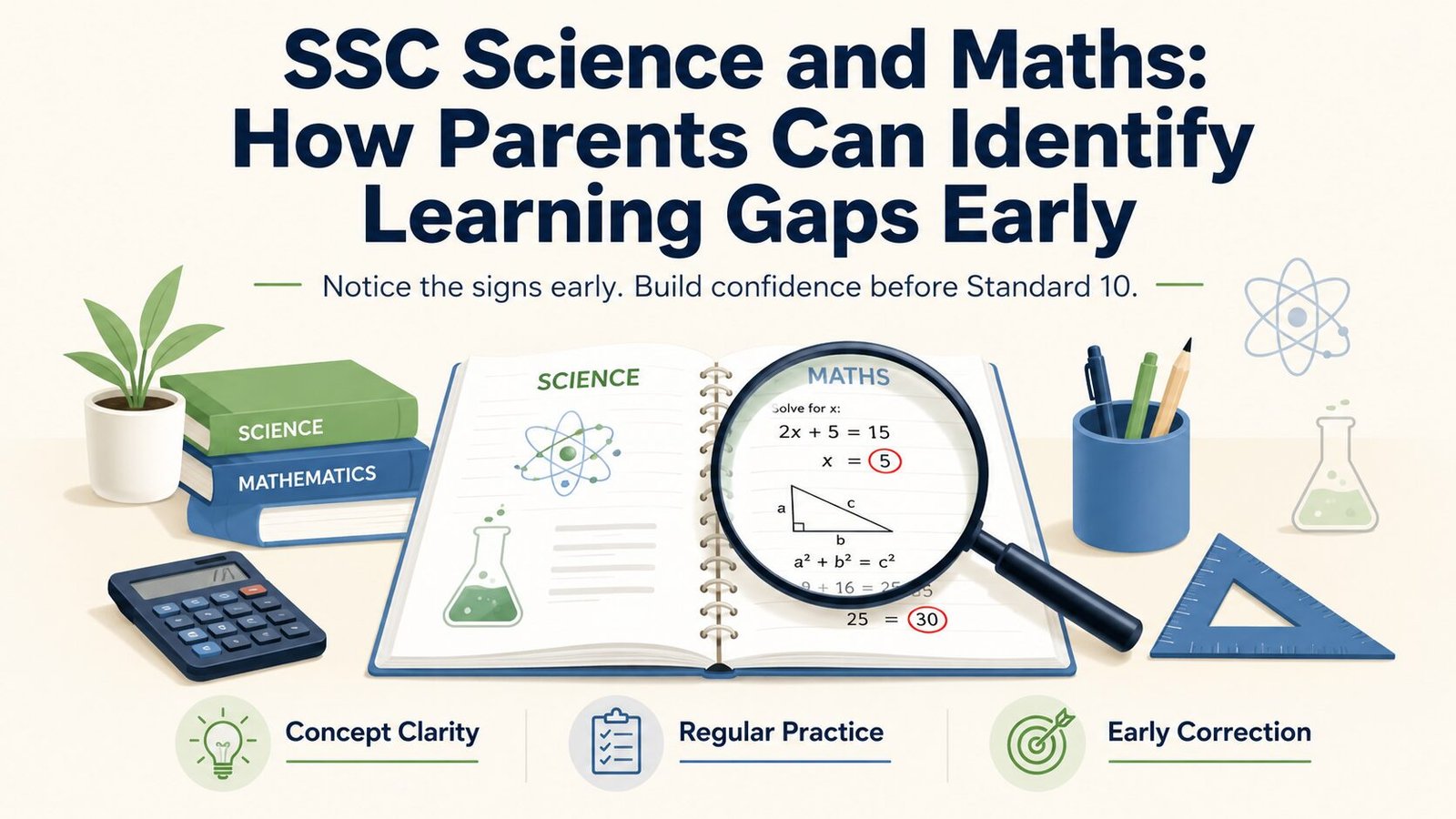
Maths gaps are usually easy to see if parents observe the child’s process, not only the final answer. A student may know the formula but not understand why it is used. The child may solve a sum when the teacher has just explained it, but get stuck when the question changes slightly.
Repeated careless mistakes are also worth watching. Sometimes they are truly careless. Sometimes they show that the child is rushing because the method is not fully clear. If the same type of mistake appears again and again, there may be a concept gap underneath.
Another sign is fear of new sums. A student who understands the method can usually attempt a different example. A student who has only memorised the steps may feel lost the moment the numbers or wording changes.
Parents should also watch for avoidance. If the child always keeps Maths for the end, gets upset during practice, or says, “I am just bad at Maths,” the issue needs attention. Confidence in Maths usually improves when the basic steps are rebuilt slowly.
Common signs of Science gaps
Science gaps can be less obvious because students may be able to read and repeat parts of the chapter. The problem becomes visible when they have to explain, draw, label or write.
A child may know the topic broadly but write very short answers. Definitions may be incomplete. Diagrams may be avoided or labelled incorrectly. In Physics and Chemistry, the student may remember a rule but not understand the reason behind it. In Biology, the student may confuse terms, structures or functions.
Parents can ask the child to explain a topic in simple language. If the child can only repeat textbook lines without understanding the meaning, the concept may not be clear. If the child says, “I know it, but I cannot explain it,” that is also a sign.
In SSC Science, textbook understanding matters. Students need to know the idea, the important terms and the way to write the answer. Reading alone is not enough. Written practice and correction are important.
Why children say “I understood” but still struggle
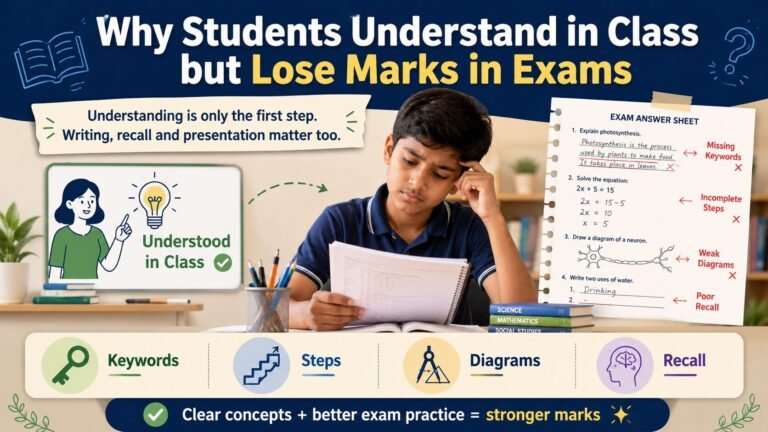
Many children genuinely believe they have understood a topic when they hear it in class. The explanation makes sense at that moment. But understanding during explanation and using the concept independently are different skills.
For example, a Maths sum may look simple when the teacher solves it step by step. When the child sits alone with a new question, the same method may not come naturally. In Science, a process may sound clear during teaching, but the child may forget the sequence while writing.
This is why practice matters. Students need to move from listening to doing. They need to solve sums, write answers, draw diagrams, make mistakes and get corrected. That is how understanding becomes stronger.
Parents should not be surprised when a child says, “I understood in class, but I could not do it in the test.” This is a common stage. It only means the child needs more guided practice.
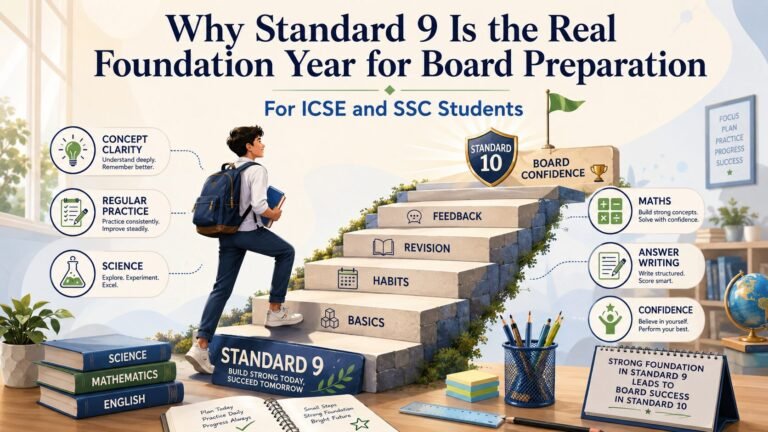
Standards 7, 8 and 9 build the base for Standard 10
Many parents begin to worry seriously only in Standard 10. That is natural because the board exam feels close. But in SSC, the foundation for Standard 10 is built much earlier.
Standards 7 and 8 shape basic comfort with Science and Maths. Standard 9 then makes the subjects more serious. The chapters become longer, the questions need more thinking, and students are expected to study with more independence.
If gaps from Standards 7 and 8 remain unresolved, Standard 9 can feel heavy. If Standard 9 remains weak, Standard 10 becomes stressful. The student then has to manage the board syllabus and old gaps together.
Early support helps because there is still time. The child can go back to basics, rebuild confidence and develop better study habits before board pressure begins.
Written work reveals what oral answers hide
Some students are good at oral answers. They can explain roughly, nod during class and participate in discussion. But when asked to write, the gaps become visible.
In Science, written work shows whether the student knows the correct terms, sequence and details. It shows whether the child can write a complete answer instead of a vague one. It also shows whether diagrams and labels are being practised properly.
In Maths, written work shows whether the child understands the steps. A final answer alone is not enough. The method should be clear, neat and logical. If the child skips steps often, the teacher needs to check whether the concept is truly understood.
This is why regular checking matters. Students improve when their actual work is reviewed. They need to know what is missing and how to correct it.
Why small batches help teachers notice gaps early
In a large batch, a quiet student can easily remain unnoticed. The child may sit in class, copy notes and avoid asking doubts. The teacher may not get enough time to check every student’s written work closely.
Small batches make it easier to notice learning gaps. In a batch of 5 to 6 students, the teacher can observe how each child thinks, solves, writes and responds. A student who is confused cannot hide for long. A repeated mistake can be caught earlier.
Small batches also help students feel more comfortable. Many children hesitate to ask doubts because they feel embarrassed. In a smaller group, they are more likely to speak up. This is especially helpful for students who have started losing confidence in Science or Maths.
Personal attention is not only about giving more time. It is about noticing the right things at the right time.
How parents can support without adding pressure
Parents play an important role, but support should not become daily stress. A child who is already afraid of a subject may withdraw further if every conversation becomes about marks.
Instead, parents can ask calmer questions. Which chapter felt difficult this week? Which type of sum is confusing? Did you write the Science answer or only read it? Is there any diagram you are avoiding? These questions help parents understand the pattern without making the child defensive.
Parents can also look at notebooks. Are corrections done? Are steps shown properly? Are diagrams labelled? Are answers too short? A notebook often tells the truth before the report card does.
The aim is not to catch the child making mistakes. The aim is to understand where help is needed.
How Dr. Manjiri Rathod’s Classes helps identify and correct gaps
Dr. Manjiri Rathod’s Classes in Nashik offer SSC Science and Mathematics support for Standards 7 to 10 in small batches. The focus is on strong foundations, clear concepts and board-ready confidence.
The teaching follows The MJR Clarity Method. The first step is Map the Gap. This means the child’s current understanding is observed carefully. The teacher looks at where the student is stuck, what has been memorised without clarity, and which habits need correction.
After that, the concept is built properly. In Science, this may mean explaining the chapter, connecting related ideas, practising diagrams and improving answer writing. In Mathematics, it may mean going back to basic steps, rebuilding the method and giving enough practice until the child becomes steadier.
The batches are deliberately small, usually 5 to 6 students. This allows Dr. Manjiri to give personal attention, notice confusion early and guide students with regular feedback. The learning environment is safe, respectful and protected, so students can ask even simple doubts without feeling judged.
A final word for parents
Learning gaps are easier to fix when they are noticed early. Parents do not need to wait for a poor result in Standard 10 before seeking support. If a child is avoiding Maths, writing weak Science answers, forgetting concepts quickly or becoming anxious before tests, it may be time to look more closely.
Science and Mathematics can become clearer with the right guidance. Students need patient teaching, regular practice, written correction and the confidence to ask doubts.
For SSC students in Standards 7 to 10, early support can make the board years much smoother. A calm, steady approach helps children move from confusion to clarity before the pressure becomes too high.
If you are looking for SSC Science and Mathematics classes in Nashik with small batches, personal attention and concept-focused teaching, Dr. Manjiri Rathod’s Classes offer academic mentorship designed to identify gaps early and build confidence step by step.
FAQs
How can parents identify learning gaps in SSC Science and Maths?
Parents can look for signs such as repeated mistakes, fear of Maths, weak Science answers, incomplete diagrams, last-minute study, difficulty explaining concepts and anxiety before tests. These signs often appear before marks fall.
Why does my child say they understood but still score less?
A child may understand during class but struggle to apply the concept independently. This is common in Science and Maths. Regular practice, written work and correction help convert classroom understanding into exam performance.
Are learning gaps common in Standards 7 to 9?
Yes. Learning gaps are common in Standards 7 to 9 because students are still building their study habits and subject foundations. If these gaps are corrected early, Standard 10 becomes much easier to manage.
How do small batches help with learning gaps?
Small batches help the teacher observe each child more closely. In a batch of 5 to 6 students, doubts, repeated mistakes and weak concepts can be noticed earlier. Students also feel more comfortable asking questions.
How does Dr. Manjiri Rathod’s Classes help SSC students?
Dr. Manjiri Rathod’s Classes help SSC students in Science and Mathematics through small-batch teaching, gap identification, concept clarity, regular practice, answer correction and personal feedback. The aim is to build strong foundations before board pressure begins.