
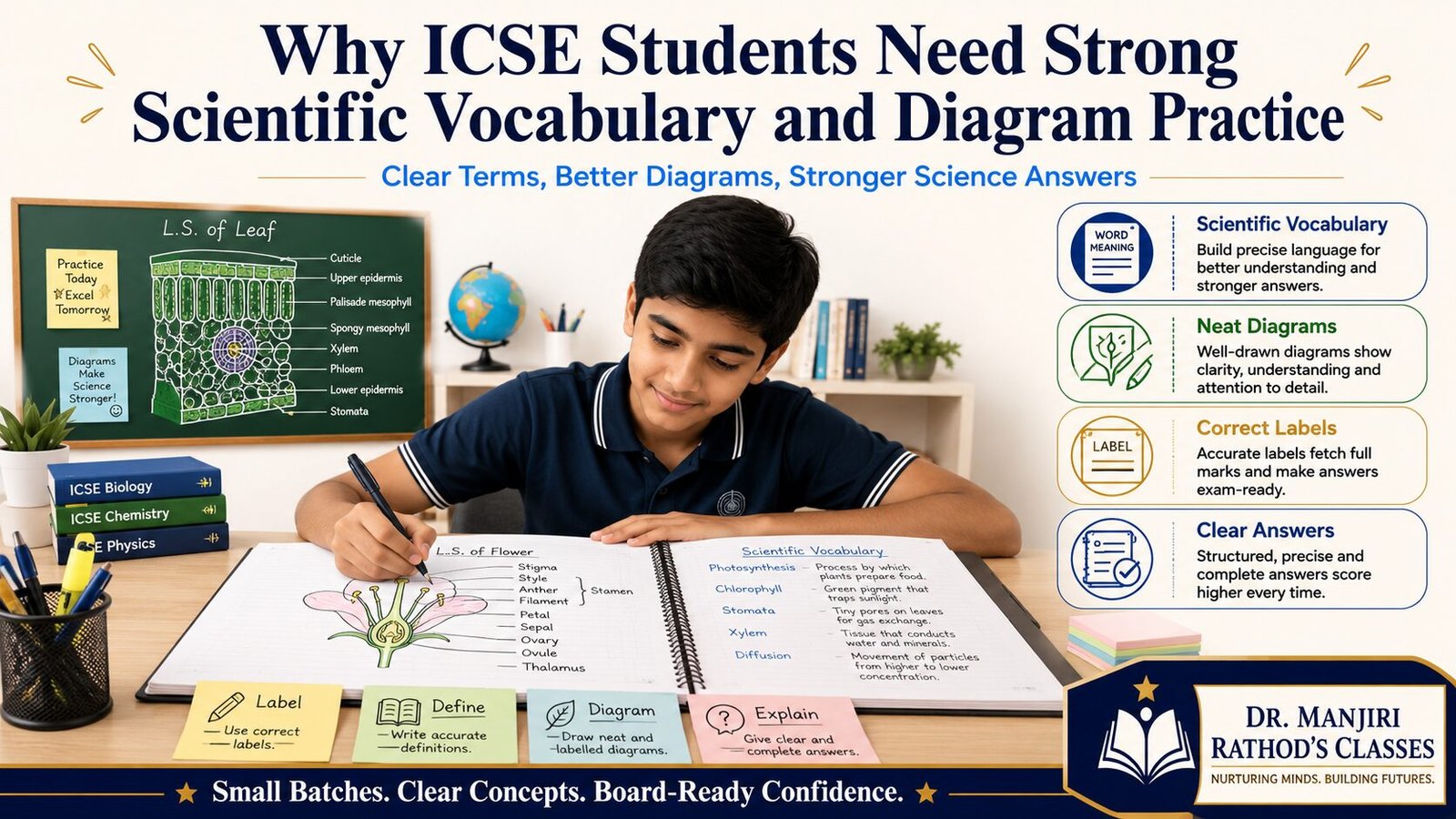
Why ICSE Students Need Strong Scientific Vocabulary and Diagram Practice
Many ICSE students understand Science when it is explained to them. They can answer orally, discuss the chapter at home, and even say, “Yes, I know this.” But when the same topic appears in a written test, the marks may not reflect that understanding.
This can be confusing for parents. The child has studied. The child seems to know the chapter. Yet the answer may be marked incomplete, the diagram may lose marks, or the explanation may not sound scientific enough.
In ICSE Science, this often happens because understanding alone is not enough. Students also need the right scientific words, clear diagrams, correct labels and structured answers. These skills should be built gradually from Standards 7 to 10, instead of being rushed only in the board year.
Why ICSE Science needs careful expression
ICSE Science is detailed. Students are expected to understand ideas and express them with clarity. This is especially true in Biology, where topics such as cells, tissues, plant processes, human body systems, reproduction, heredity and health need proper terms and diagrams.
A student may know that the heart pumps blood. But in an ICSE answer, the student may need to mention chambers, valves, blood vessels, oxygenated blood, deoxygenated blood and the direction of flow. A rough idea will not always be enough.
This is where scientific vocabulary becomes important. The child should know the meaning of the term, how to spell it, where to use it and how it connects with the rest of the chapter. When students become comfortable with this language, Science becomes much easier to write.
Scientific terms should make sense to the child
Many students try to memorise scientific terms without really understanding them. This creates stress because Biology and Science have many words that look long, sound similar or feel unfamiliar.
Words like chlorophyll, osmosis, diffusion, transpiration, respiration, stimulus, tissue, enzyme, artery, vein and chromosome can feel heavy at first. But once the meaning is explained properly, the fear reduces. A child who understands the term is more likely to remember it and use it correctly in an answer.
For example, if a student only memorises the word “transpiration,” it may remain a textbook word. But if the teacher explains it through a leaf, water movement, stomata and evaporation, the term becomes connected to a real process. The word then becomes easier to recall.
Good ICSE Science teaching should help students build this comfort with terminology. The aim is not to make children mug up difficult words. The aim is to make those words familiar and meaningful.
Why students understand orally but struggle in writing
This is a very common pattern. A student may explain a topic in simple language at home, but the written answer may still lose marks. The reason is usually expression.
Oral explanation allows the child to speak loosely. The child can use hand gestures, incomplete sentences and everyday words. Written answers need more discipline. The answer should have the right sequence, correct terms and enough detail.
In ICSE Science, a vague answer can weaken the student’s marks even when the basic understanding is present. For example, writing “the food goes down and gets digested” may show a general idea, but it does not show scientific understanding. The answer needs organs, enzymes, processes and proper flow.
This is why students should practise writing regularly. Reading the chapter is useful, but writing shows whether the child can express the idea properly. When written work is checked and corrected, students slowly learn how to improve.
Diagrams are a scoring skill
In ICSE Science, diagrams play a very important role. They help students show structure, organisation and understanding. In Biology especially, a diagram can make an answer clearer and stronger.
Many students leave diagram practice for later. They think they will manage it before the exam. This usually creates problems. Diagrams need hand practice. The child should know how to draw the structure neatly, place labels correctly and avoid careless mistakes.
A good diagram does not have to be artistic. It has to be clear, proportionate and labelled properly. The label lines should be neat. The spelling should be correct. The important parts should be shown clearly. These small habits can make a difference in marks.
Parents should encourage students to practise diagrams throughout the year. Waiting until the final weeks makes the work feel bigger than it actually is.
Labels matter more than students realise
Students often draw a diagram but lose marks because the labels are incomplete or incorrect. This is frustrating because the child may feel, “I drew it, so why did I lose marks?” In Science, the label is part of the answer. A diagram without proper labels is only half useful.
Labels show whether the child knows the parts and their placement. In Biology, the position of a label matters because structure and function are connected. If a student labels carelessly, it may show confusion even if the drawing looks decent.
This is why diagram practice should include labelling practice. Students should say the names aloud, write them correctly and understand what each part does. Once this habit is built, diagrams become less stressful.
Standards 7 to 9 are the right time to build these habits
Many parents begin to worry about answer writing and diagrams only in Standard 10. That is understandable because the board exam feels close then. But the habits needed for Standard 10 should ideally begin earlier.
Standards 7, 8 and 9 are important years for ICSE students. These are the years when the child can slowly learn how to read Science, understand terms, draw diagrams, write answers and revise properly. There is still enough time to correct mistakes without too much pressure.
If a child reaches Standard 10 without these habits, the board year becomes heavier. The student has to manage new chapters, revision, school tests and old gaps together. This can create stress that could have been avoided with earlier support.
Starting early does not mean putting board pressure on the child. It means helping the child become more comfortable with the subject before the pressure begins.
Scientific vocabulary supports answer writing
Strong vocabulary helps students write better answers. When the right words are available, the answer becomes more precise. The child does not have to depend on vague explanations.
For example, in Biology, a student may need to explain absorption, circulation, excretion, pollination or reproduction. Each topic has specific terms. If the child knows them well, the answer becomes clearer and more complete.
Scientific vocabulary also helps in definitions. Many definitions in Science need careful wording. If the child changes key terms or writes too casually, the definition may lose accuracy. Regular practice helps students understand which words are essential and which details support the answer.
This is one reason why Science should be taught with patience. Students need time to become comfortable with the language of the subject.
Diagram practice supports memory
Diagrams do more than improve marks. They also help students remember the chapter better. When a child draws a plant cell, a leaf, the human heart or the digestive system, the structure becomes clearer in the mind.
Visual learning is especially helpful in Biology. Many processes make more sense when the student can see the parts involved. A labelled diagram helps connect the name, the position and the function.
For some students, diagrams are the easiest way to revise. Once the structure is clear, the written explanation also becomes easier. This is why diagram practice should be treated as part of learning, not as an extra task.
Small batches help students get corrected properly
Scientific vocabulary and diagrams need correction. A child may write the wrong term repeatedly without realising it. A diagram may have the same labelling mistake every time. These errors continue unless someone notices them and corrects them carefully.
In a large batch, individual correction can become difficult. Some students may remain quiet, copy the corrected answer from someone else and still not understand their own mistake. This is especially common with shy students.
Small batches help because the teacher can observe more closely. In a batch of 5 to 6 students, each child gets more attention. Doubts can be discussed properly. Written answers and diagrams can be checked with more care. Students also feel more comfortable asking simple questions.
For ICSE students, this personal attention matters because the subject needs both understanding and expression.
How Dr. Manjiri Rathod’s Classes supports ICSE Science learning
Dr. Manjiri Rathod’s Classes in Nashik offer Science-focused academic support for ICSE students in Standards 7 to 10, including Biology. Mathematics and Chemistry may also be supported depending on student need and batch structure.
The teaching is built around strong foundations, clear concepts and board-ready confidence. For ICSE Science, this means helping students understand the chapter, use scientific terms correctly, practise diagrams and write answers with better structure.
Dr. Manjiri Rathod brings a PhD Life Sciences background and over 20 years of teaching and mentoring experience. This is especially useful for Biology because the subject needs depth, clarity and careful explanation. At the same time, the learning environment remains warm and student-friendly, so young students do not feel intimidated.
The classes follow The MJR Clarity Method. First, the child’s learning gaps are identified. Then the concept is built properly. Related ideas are connected so the child sees the larger picture. After that, students practise writing for the board. Regular feedback helps reinforce learning.
This approach is helpful for ICSE students because vocabulary, diagrams and answer writing improve only with regular practice and correction.
A final word for parents
If your child understands Science orally but loses marks in written tests, the issue may not be lack of effort. The child may need help with scientific vocabulary, diagrams, labels and answer structure.
These skills can be built. They do not have to become a source of fear. With the right guidance, students can become more comfortable with scientific terms, more confident with diagrams and clearer in their written answers.
For ICSE students in Standards 7 to 10, this preparation should begin early. A calm, steady approach helps children build the habits they need before Standard 10 arrives.
If you are looking for ICSE Science support in Nashik, Dr. Manjiri Rathod’s Classes offer small-batch academic mentorship with personal attention, concept clarity and regular feedback in a safe and respectful learning environment.
FAQs
Why do ICSE students need strong scientific vocabulary?
ICSE Science often expects students to use correct scientific terms in answers. When students understand and use these terms properly, their answers become clearer, more accurate and more complete.
Why are diagrams important in ICSE Science?
Diagrams help students show structure and understanding, especially in Biology. A neat, correctly labelled diagram can support the written answer and help students score better.
My child understands Science but loses marks. What could be the reason?
Many students understand topics orally but struggle to write them properly. They may miss keywords, write incomplete explanations, make labelling mistakes or avoid diagrams. Regular written practice and correction can help.
When should ICSE students start practising diagrams and answer writing?
Students should begin practising diagrams and answer writing from Standards 7 to 9. This helps them build good habits before Standard 10 and reduces last-minute pressure.
How does Dr. Manjiri Rathod’s Classes help ICSE students with Science?
Dr. Manjiri Rathod’s Classes help ICSE students through small batches, concept-based teaching, scientific vocabulary support, diagram practice, answer writing and regular feedback. The focus is on helping students understand clearly and prepare with confidence.