Why Standard 9 Is the Real Foundation Year for Board Preparation
For many parents, Standard 10 feels like the real board year. That is when the exam becomes official, the pressure becomes visible, and everyone starts talking about marks, revision, test series and preparation plans.
Standard 9, meanwhile, is often treated as the year before the serious year. The child has entered high school, yes, but the board exam still feels one step away.
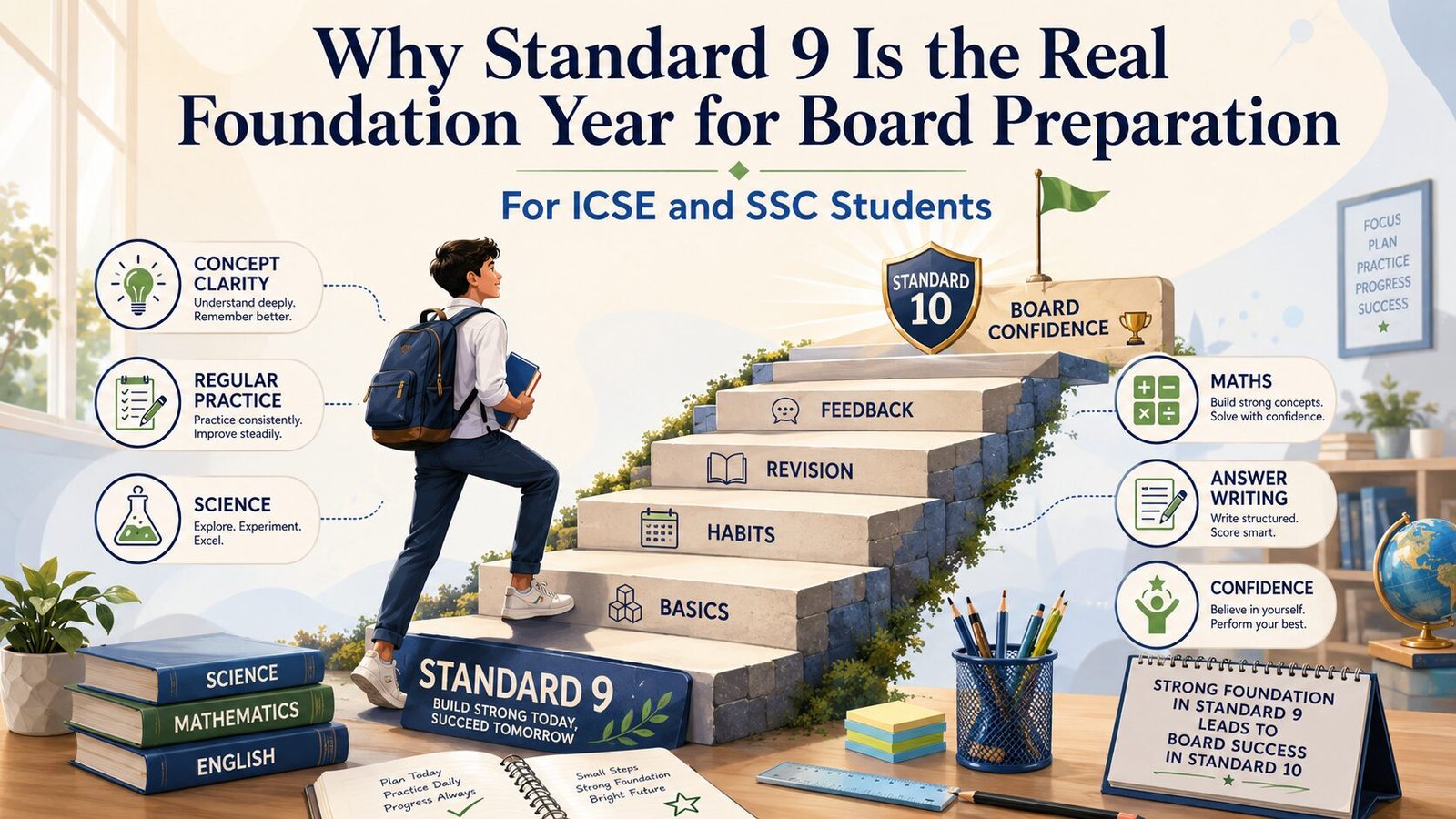
In reality, Standard 9 is one of the most important academic years for both ICSE and SSC students. It is the year where earlier gaps begin to show, subjects become more demanding, and study habits start affecting performance more clearly. A child who builds a strong foundation in Standard 9 usually enters Standard 10 with much more confidence.
That is why parents should look at Standard 9 as the real foundation year for board preparation.
Why Standard 9 feels different
Standard 9 is usually the year where students realise that school work has become more serious. The chapters are longer, the questions are more detailed, and students are expected to study with more independence.
In earlier standards, a child may manage with some reading, some memorising and some help before tests. In Standard 9, this approach often begins to feel weak. Science requires better understanding. Mathematics needs regular practice. Answers need more structure. Diagrams, definitions, reasons, numericals and explanations all become more important.
This change can surprise students. A child who was comfortable in Standard 8 may suddenly feel that the same subjects are harder. Parents may notice that the child is spending more time studying, yet the marks are not improving in the same way.
This does not always mean the child has become careless. Very often, Standard 9 simply exposes learning habits that were not strong enough.
Gaps from Standards 7 and 8 become visible
Learning gaps rarely appear suddenly. They usually build quietly over time. A student may not have fully understood a Maths concept in Standard 7. A Science topic in Standard 8 may have been memorised without proper clarity. The child may have avoided diagrams, skipped difficult questions or depended too much on last-minute preparation.
In Standard 9, these gaps become easier to see. In Mathematics, one weak concept can affect several later chapters. In Science, earlier ideas often connect with new topics. If the basic foundation is unclear, the new chapter feels heavier than it should.
This is where parents should be careful. The solution is not to scold the child or assume the child is not trying. The better approach is to identify the gap calmly and fix it before Standard 10 begins.
The earlier the gap is noticed, the easier it is to correct. Standard 9 gives students that time.
Science becomes more connected
In Standard 9, Science is no longer only about learning separate chapters. Students need to start seeing how ideas connect. Biology, Chemistry and Physics each become more structured, and each subject expects clearer thinking.
For ICSE students, Science often becomes more detailed. Biology may involve deeper terminology, diagrams, processes and explanation-based answers. Students need to understand the meaning of scientific words and use them properly in writing. They also need regular diagram practice.
For SSC students, Science needs strong textbook understanding, clear basics and steady written practice. Students must learn how to write complete answers, handle reasons, practise diagrams and connect Science with Mathematics where needed, especially in numerical-based topics.
In both boards, memorising answers without understanding becomes risky. The child may manage one test, but the confidence does not last. Standard 9 is the right time to build real concept clarity.
Mathematics needs steady practice
Mathematics is a subject where confidence grows through regular practice. Many students do not dislike Maths from the beginning. They start fearing it when they repeatedly get stuck and do not know how to recover.
In Standard 9, Maths often becomes a turning point. The steps become longer, the formulas need better understanding, and careless mistakes start affecting marks. A child may know the method in class but struggle when solving alone at home.
Parents should watch for signs like avoiding Maths homework, copying solved examples without attempting fresh sums, getting nervous before tests, or saying, “I know this,” but making the same mistake again.
The goal in Standard 9 should be to make Maths more stable. Students need to understand the method, practise enough examples, correct mistakes and slowly build speed. This cannot happen in a rush just before Standard 10.
Answer writing starts to matter more
Many students study the chapter and still lose marks because they do not write well. This happens in both Science and other theory-based subjects, but Science makes the problem very visible.
A student may understand a process orally but write an incomplete answer. The answer may miss keywords. The diagram may be unlabelled. The explanation may be too short. In Maths, the child may skip steps and lose marks even when the final answer is correct.
Standard 9 is the right time to correct this habit. Students should learn how to read the question, understand what is being asked, write in proper sequence and include the required terms. They should also learn how to present diagrams and solutions neatly.
Board-ready writing does not begin only in Standard 10. It begins when the child starts practising clear expression before the pressure becomes too high.
Standard 9 helps reduce Standard 10 panic
One of the biggest advantages of strong Standard 9 preparation is that Standard 10 becomes less frightening. The child enters the board year with better habits, clearer basics and more confidence.
When students wait until Standard 10 to fix everything, the year becomes overloaded. They have to manage the new syllabus, school exams, revision, tests and old gaps at the same time. This can create unnecessary stress for both children and parents.
Standard 9 gives the child breathing space. There is time to identify weak areas, improve answer writing, practise diagrams, strengthen Maths and build a regular study rhythm. This kind of preparation feels calmer and more sustainable.
Parents should not think of Standard 9 support as extra pressure. Done properly, it reduces pressure.
Small batches can help students open up
Standard 9 students are still young. Many of them hesitate to ask doubts, especially in a large group. Some are afraid their question will sound silly. Some do not want other students to know they are confused. Some simply nod along and hope they will understand later.
This is where small-batch learning can make a real difference.
In a batch of 5 to 6 students, the teacher can observe each child more closely. It becomes easier to notice who is following, who is quiet, who is making repeated mistakes and who needs a concept explained again. Students also feel more comfortable asking questions because the space feels less crowded.
For young learners, comfort matters. A child who feels safe and respected is more likely to ask doubts, attempt answers and accept correction. This is especially important in Standard 9, because the right guidance at this stage can prevent larger academic stress later.
Parents should look beyond marks alone
Marks are important, but they do not always tell the full story. A child may score decently after memorising before a test, yet still have weak understanding. Another child may score less in one exam but show better thinking and improvement over time.
In Standard 9, parents should look at learning patterns along with marks. Is the child understanding concepts? Is the child able to explain topics in simple words? Is written work improving? Are diagrams becoming neater? Is the child making fewer repeated mistakes in Maths? Is the child becoming more willing to ask doubts?
These signs matter because board preparation is not built in one exam. It is built through steady improvement.
How Dr. Manjiri Rathod’s Classes supports Standard 9 students
Dr. Manjiri Rathod’s Classes in Nashik are built around small-batch academic mentorship for school students. For SSC Standards 7 to 10, the focus is Science and Mathematics. For ICSE Standards 7 to 10, the support is Science-focused, including Biology, with Mathematics and Chemistry depending on student need and batch structure.
Standard 9 students benefit from this approach because the teaching is not only about completing chapters. The aim is to build strong foundations, clear concepts and board-ready confidence before Standard 10 begins.
The classes follow The MJR Clarity Method. First, the child’s learning gaps are mapped. Then the concept is built properly. Related ideas are connected so the student understands the bigger picture. After that, the child learns how to write for the board. Regular feedback helps reinforce learning.
Dr. Manjiri Rathod brings a PhD Life Sciences background and over 20 years of teaching and mentoring experience. At the same time, the classroom approach remains warm, patient and student-friendly. The small-batch format helps students feel comfortable asking doubts and learning at a more personal pace.
A final word for parents
Standard 9 is an important year because it gives students time. Time to correct gaps. Time to build habits. Time to understand Science and Mathematics more clearly. Time to practise answer writing before board pressure begins.
Parents do not need to wait for Standard 10 to take academic support seriously. A calm, steady approach in Standard 9 can make the board year much smoother.
The right support should help the child feel clearer, more confident and less afraid of difficult subjects. That is the real value of starting at the foundation stage.
If you are looking for small-batch academic support in Nashik for Standard 9 Science and Mathematics, or ICSE Science-focused preparation, Dr. Manjiri Rathod’s Classes offer personal attention, concept clarity and board-aware guidance in a safe and respectful learning environment.
FAQs
Why is Standard 9 important for board preparation?
Standard 9 is important because it builds the academic foundation for Standard 10. Students develop study habits, strengthen concepts, improve answer writing and begin handling more serious Science and Mathematics topics.
Should students start board preparation in Standard 9?
Yes, students should start preparing steadily in Standard 9. This does not mean putting board pressure on the child early. It means building clarity and habits before Standard 10 becomes stressful.
Why do Science and Mathematics become difficult in Standard 9?
Science and Mathematics become more connected and detailed in Standard 9. Students need stronger basics, regular practice and clearer understanding. Earlier gaps from Standards 7 and 8 often become visible at this stage.
Are small-batch classes useful for Standard 9 students?
Small batches are useful because students get more personal attention and feel more comfortable asking doubts. In a batch of 5 to 6 students, the teacher can notice confusion earlier and guide each child more closely.
How does Dr. Manjiri Rathod’s Classes help Standard 9 students?
Dr. Manjiri Rathod’s Classes help Standard 9 students through small-batch mentoring, concept-based teaching, gap identification, board-style writing practice and regular feedback. The focus is on strong foundations, clear concepts and board-ready confidence.