ICSE Science vs SSC Science: Why Preparation Needs a Different Approach
For many parents, Science feels like the same subject across boards. Cells are cells, force is force, acids and bases are acids and bases. So it is natural to wonder why an ICSE student and an SSC student may need a different kind of academic support.
The difference is not that one child is more capable or one board is “better” than the other. The difference lies in how the subject is taught, how deeply it is expected to be understood, how questions are asked, and how answers need to be written. Once parents understand this, it becomes easier to choose the right kind of class for their child.
For students in Standards 7 to 10, Science is no longer just about reading the textbook and remembering answers. It slowly becomes a subject that needs clarity, vocabulary, diagrams, reasoning and regular writing practice. ICSE and SSC both need these skills, but the balance is different.
Why parents should understand the board difference
Many children start struggling in Science because their preparation style does not match the board’s expectations. They may study sincerely, attend school, complete homework and still feel unsure during tests. This usually happens when the child is preparing in a general way, without understanding what the board actually expects.
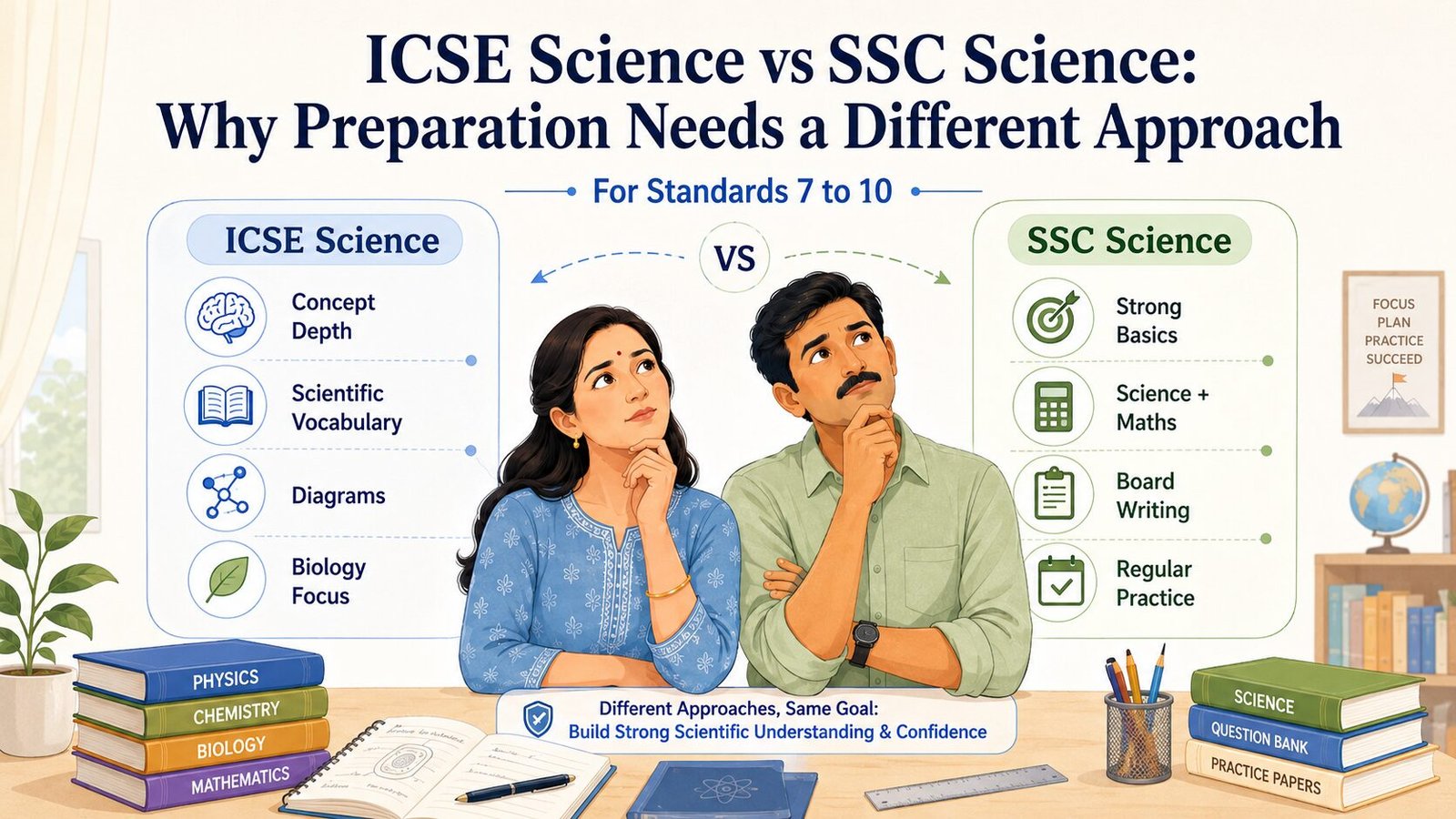
An ICSE student may need more focus on depth, terminology, diagrams and explanation-based answers. An SSC student may need strong textbook understanding, clear basics, regular written practice and steady preparation in Science and Mathematics together. Both students need concept clarity, but the teaching approach should suit the child’s board and learning pattern.
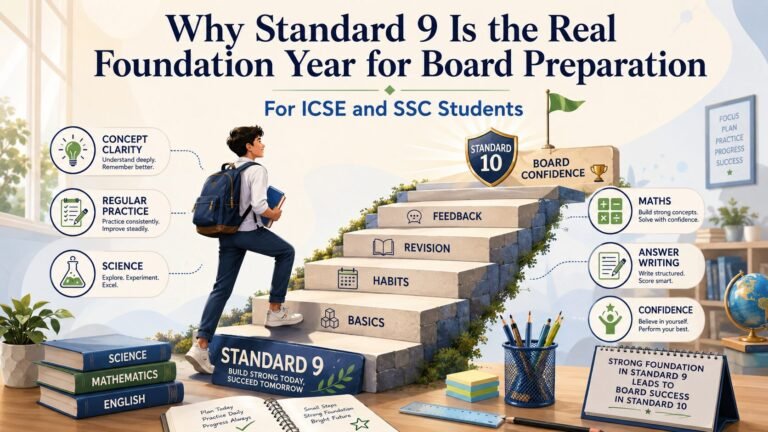
This matters especially in Standards 7, 8 and 9. These years quietly decide how comfortable the child will feel in Standard 10. If the foundation is built well, board preparation becomes much calmer later.
How ICSE Science usually feels to students
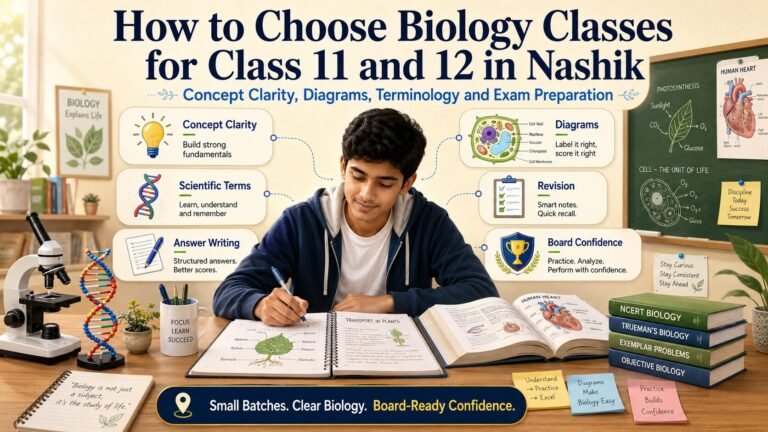
ICSE Science can feel detailed and language-heavy for many students. The chapters often require students to understand processes, use precise scientific terms, draw labelled diagrams and explain ideas in a structured way. Biology, in particular, can become challenging if students try to memorise without understanding.
For example, a student may know that photosynthesis is related to plants making food. But in ICSE, the student may also need to understand the process, the role of chlorophyll, the importance of sunlight, the movement of gases, the structure of the leaf and the way the answer should be written. The subject asks for more than a rough idea.
This is why ICSE students often need patient explanation. They need to understand the meaning behind scientific terms. They need to practise diagrams carefully. They also need help with answer writing, because knowing the idea orally and writing it properly in an exam are two different skills.
How SSC Science usually feels to students
SSC Science has its own challenges. Many students feel that if they read the textbook and prepare answers before exams, they can manage. That may work for a short time, but it does not always build confidence. When students reach higher standards, weak basics in Science and Mathematics can begin to show.
In SSC, the child needs clear textbook understanding, regular practice and the ability to write complete answers. Students also need to handle diagrams, definitions, reasons, numericals and application-based questions. If they study only at the last moment, they may remember points temporarily but forget them quickly.
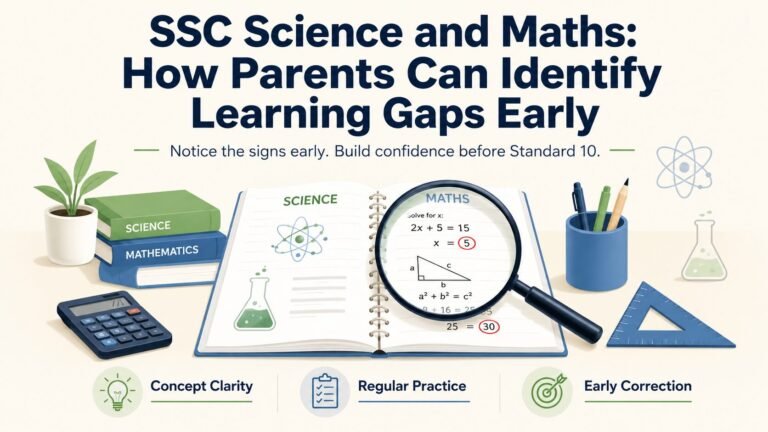
For SSC students, Science and Mathematics often need to be supported together. A child who struggles with Physics may also struggle with the mathematical steps involved. A child who is weak in basic calculation may become nervous when Science includes numerical questions. This is why steady preparation in both subjects helps.
The role of language and vocabulary
One major difference between ICSE and SSC Science is the way students experience scientific language. ICSE students often need to become comfortable with a wider scientific vocabulary earlier. They may have to understand terms, spell them correctly, use them in answers and connect them with diagrams.
This can be difficult for students who understand the idea but do not yet have the language to express it. Parents may see this when a child explains a topic casually at home but writes a weak answer in the notebook. The concept is partly there, but the expression is not yet strong.
SSC students also need correct terms, but the preparation often needs more attention to textbook-based clarity and answer completeness. The child should know which terms must be used, how much explanation is needed and how to avoid vague writing.
In both boards, vocabulary should not be treated as memorisation alone. Students need to understand the meaning of scientific words. Once the word makes sense, the answer becomes easier to write.
Diagrams matter in both boards
Science diagrams are a common source of lost marks. Students often leave them for later, draw them carelessly or forget labels. This happens in both ICSE and SSC, though the level of detail may differ.
In ICSE Biology, diagrams can carry strong importance because they show whether the child understands the structure and its function. A neat diagram with correct labels can make the answer clearer. An incomplete diagram can weaken an otherwise good answer.
In SSC Science too, diagrams need regular practice. Students should learn how to draw them neatly, label them correctly and use them when the question requires it. Diagrams should not feel like an extra burden before the exam. They should become part of regular study.
A good Science class should therefore include diagram practice throughout the year. Children improve when they draw, make mistakes, get corrected and try again.
Answer writing is where many students lose marks
Parents often hear children say, “I knew the answer, but I did not get marks.” This is one of the most common problems in Science. The child may have studied, but the answer may not match what the examiner expects.
ICSE answer writing often needs clear explanation, correct terms and proper structure. Students may need to explain processes, compare concepts or write reason-based answers. They need to know how to organise the answer so that the important points are visible.
SSC students also need answer-writing practice. They should know how to frame definitions, write reasons, show steps in numericals, label diagrams and avoid incomplete answers. Many students lose marks because they write too briefly or skip key words.
This is why Science preparation should include written work. Reading alone is not enough. Students need to write, receive feedback and improve gradually.
Concept clarity is needed in both ICSE and SSC
The teaching approach may differ, but concept clarity is central for both boards. A child who understands the concept can handle questions with more confidence. A child who has only memorised answers may feel lost when the question is slightly changed.
For ICSE students, concept clarity helps them manage depth and detail. For SSC students, it helps them avoid last-minute memorisation and build stronger basics. In both cases, the teacher should explain the idea in a way the child can follow.
This is especially important in Standards 7 to 9. Students are still building their learning habits. If they begin to understand Science as a connected subject, Standard 10 becomes less stressful. If they treat every chapter as a separate set of answers to memorise, the pressure keeps growing.
Why small batches help both ICSE and SSC students
Many students do not ask doubts in a large group. They may feel shy, afraid or unsure whether their question is important. Some children simply stay quiet and hope they will understand later. Unfortunately, the gap often remains.
In a small batch, the teacher can notice confusion earlier. The child also gets more chances to speak, ask, write and receive correction. This is useful for both ICSE and SSC students because Science needs interaction. The teacher has to know whether the child has actually understood.
For younger students, comfort matters. A student who feels safe asking a simple question is more likely to improve. A student who feels ignored may slowly lose confidence in the subject.
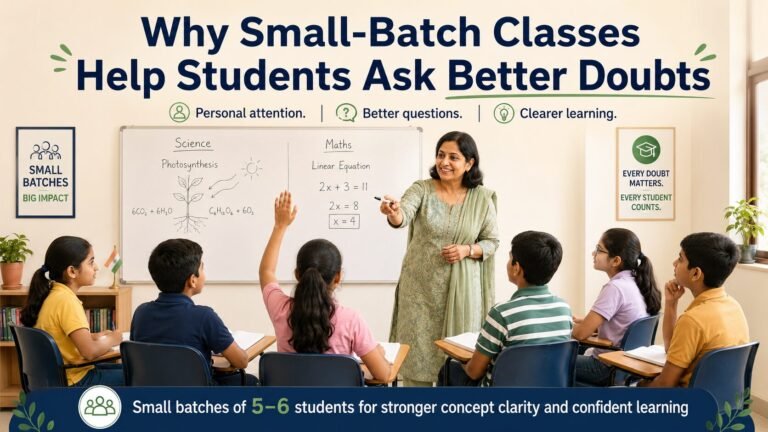
Small batches of 5 to 6 students allow personal attention without making the child feel exposed or pressured. This balance is especially helpful in Standards 7 to 10.
Why teacher background matters in Science
Science teaching needs clarity and subject comfort. When a teacher has strong academic depth, the explanation becomes richer and more connected. This is especially useful in Biology and Life Sciences, where students need to understand living systems, processes, structures and functions.
At the same time, school students do not need a heavy academic lecture. They need the subject to be explained in a way that feels simple, patient and age-appropriate. A strong teacher knows how to reduce confusion without reducing the seriousness of the subject.
This is where Dr. Manjiri Rathod’s background makes a difference. As a PhD Life Sciences educator with over 20 years of teaching and mentoring experience, she brings subject depth to the classroom. But the small-batch format keeps the learning personal and comfortable for young students.
How Dr. Manjiri Rathod’s Classes approach board-specific learning
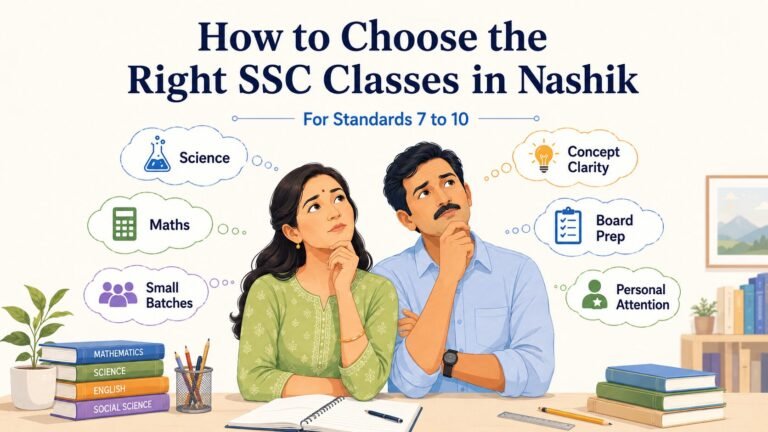
Dr. Manjiri Rathod’s Classes in Nashik are built around small-batch academic mentorship. For ICSE students in Standards 7 to 10, the support is Science-focused, including Biology, with Mathematics and Chemistry depending on the child’s need and batch structure. For SSC students in Standards 7 to 10, the focus is Science and Mathematics.
The teaching follows The MJR Clarity Method. First, the child’s learning gaps are identified. Then the concept is built properly. Related ideas are connected so the child understands the larger picture. After that, students learn to write for the board. Regular feedback helps reinforce what they have learnt.
This method is useful because it does not treat all students as the same. An ICSE student may need deeper vocabulary, diagrams and explanation-based writing. An SSC student may need stronger basics, Maths confidence and steady written practice. The core promise remains the same: strong foundations, clear concepts and board-ready confidence.
What parents should look for while choosing Science support
Parents should look for a class that understands the child’s board and learning style. A general class may complete chapters, but board-specific support helps the child prepare in the right direction.
For ICSE students, ask whether the class gives enough attention to scientific vocabulary, diagrams, Biology depth and structured answers. For SSC students, ask whether the class supports both Science and Mathematics, checks written work and strengthens basics before Standard 10.
Parents should also ask about batch size. If the class is too crowded, quieter students may not receive enough attention. A small, respectful learning space can help children ask doubts without fear.
Most importantly, the class should make the child feel clearer after every few weeks. That is the real sign of progress.
A final word for parents
ICSE Science and SSC Science both need sincere preparation, but they do not need the exact same approach. ICSE often needs more depth, terminology, diagrams and detailed explanation. SSC needs strong textbook understanding, steady practice, Science and Maths support, and board-style answer writing.
For parents, the aim should be to choose a class that understands these differences and also understands the child sitting in front of the teacher. Marks are important, but confidence, clarity and comfort matter too.
If you are looking for board-specific Science support in Nashik, Dr. Manjiri Rathod’s Classes offer small-batch academic mentorship for ICSE and SSC students, with personal attention, concept clarity and board-aware preparation.
FAQs
What is the main difference between ICSE Science and SSC Science preparation?
ICSE Science usually needs more depth, scientific vocabulary, diagram practice and explanation-based writing. SSC Science needs clear textbook understanding, regular written practice, strong basics and steady preparation for board-style questions.
Do ICSE students need special support in Biology?
Many ICSE students benefit from strong Biology support because the subject includes detailed processes, diagrams, terminology and structured answers. A teacher with a Life Sciences background can help students understand the subject more clearly.
Why do SSC students need Science and Mathematics support together?
Science and Mathematics are connected in many areas, especially in Physics and numerical-based topics. If a child has weak Maths basics, some Science topics may also feel difficult. Supporting both subjects helps build stronger confidence.
Are small batches useful for both ICSE and SSC students?
Yes. Small batches help students ask doubts more comfortably and receive closer attention. In a batch of 5 to 6 students, the teacher can notice learning gaps earlier and guide each child better.
How does Dr. Manjiri Rathod’s Classes support ICSE and SSC students?
Dr. Manjiri Rathod’s Classes support ICSE and SSC students through small-batch academic mentorship, concept-based teaching, board-style writing practice and regular feedback. The teaching follows The MJR Clarity Method, which helps students move from gaps to clearer understanding.