
How to Choose the Right SSC Classes in Nashik for Standards 7 to 10
Choosing the right SSC classes in Nashik for a child in Standards 7 to 10 is an important decision for many parents. These are the years when Science and Mathematics slowly become more serious. The chapters become longer, the questions need clearer answers, and students begin to realise that last-minute study is not always enough.
At the same time, children in these standards are still young. They need guidance, but they also need comfort. A good class should help them understand, ask doubts, practise regularly and feel less afraid of difficult subjects.
So, when parents look for SSC classes, the question should go beyond “Will the syllabus be completed?” A better question is, “Will my child actually become clearer and more confident in Science and Maths?”
Why choosing SSC classes needs care
In SSC, many students manage the early years with some reading, some memorising and some help before exams. This may work for a while. But as they move closer to Standard 10, gaps in Science and Mathematics begin to show more clearly.
A child who has not understood basic concepts in Mathematics may struggle with later sums. A child who has only memorised Science answers may find it difficult to explain reasons, draw diagrams or write complete answers. These problems do not appear suddenly in Standard 10. They usually build quietly over Standards 7, 8 and 9.
That is why the right class should focus on steady learning. It should help the child understand the subject, practise properly and prepare in a board-aware way without creating unnecessary fear.
What usually goes wrong in Science and Mathematics
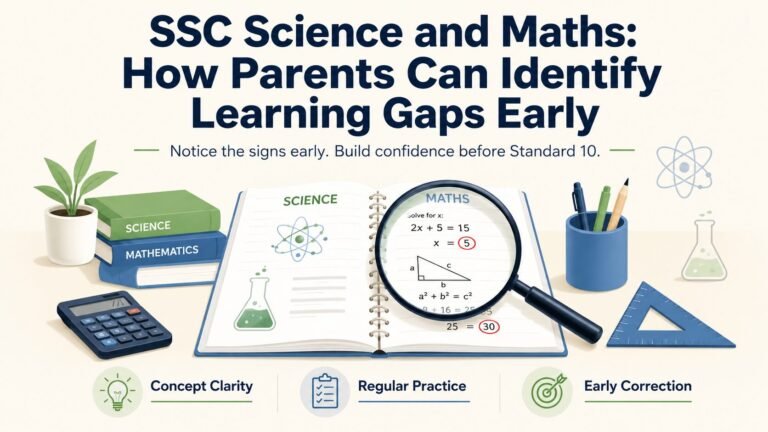
Science and Mathematics are subjects where small gaps can become bigger over time. In Maths, students may know the formula but not understand when to use it. They may copy steps in class but get stuck when the numbers change. Some children begin to believe they are “not good at Maths,” when the real issue is that a few basics were never made clear.
Science has a different kind of challenge. Students may read the chapter and feel they know it, but when they write answers, they miss key points. Diagrams may be incomplete. Definitions may be vague. In Physics and Chemistry, students may struggle with the reason behind a concept. In Biology, they may remember the topic broadly but forget the correct terms.
Parents often see the result only after a test. The child says, “I studied,” and that may be true. But studying without clarity does not always lead to marks. A good SSC class should help students study in the right way.
Start by observing your child’s learning pattern
Before choosing a class, parents can quietly observe how the child learns at home. Does the child avoid Maths homework until the last moment? Does the child say Science is easy but then lose marks in written answers? Does the child need repeated explanation for the same type of sum? Does the child become nervous before tests even after studying?
These signs are useful. They do not mean the child is weak or careless. Many students simply need a more personal way of learning. They need someone to explain patiently, check their work, correct mistakes and help them build confidence slowly.
It also helps to notice whether the child asks doubts. Some children are very quiet in class. They may nod when the teacher explains, but they may not say when they are confused. In a large group, such students can easily remain unnoticed. This is where the learning environment and batch size matter.
Choose a class that teaches concepts patiently
For SSC students, concept clarity is the base of both Science and Mathematics. In Maths, a child should understand the method, not merely copy the solution. In Science, a child should understand the reason behind the answer, not only memorise textbook lines.
Patient teaching helps students stop fearing the subject. A teacher may need to explain the same idea in two or three ways before the child becomes comfortable. That is normal. Children learn at different speeds, especially in the middle school years.
The right class should make difficult chapters feel manageable. It should break topics into smaller parts, connect them to what the child already knows, and then move towards exam-style practice. When this happens consistently, students begin to participate more confidently.
Look for Science and Mathematics support together
For SSC Standards 7 to 10, Science and Mathematics often need support side by side. Both subjects require regularity. Both need practice. Both become stronger when the basics are clear.
In Science, students need help with concepts, diagrams, definitions, reasons and written answers. In Mathematics, they need step-by-step solving, formula understanding, repeated practice and correction of mistakes. A student may be comfortable in one subject and hesitant in the other. A good academic support system should be able to notice this difference.
At Dr. Manjiri Rathod’s Classes in Nashik, the SSC focus is on Science and Mathematics for Standards 7 to 10. The aim is to help students build strong foundations, understand concepts clearly and become more prepared for school exams and board-level expectations.
Check how doubts are handled
Doubt-solving is one of the clearest signs of a good class. Many students do not need more pressure. They need more chances to ask questions without feeling embarrassed.
In a crowded batch, a child may hesitate to ask a basic doubt. The teacher may also have limited time to check whether each student has understood. The child may continue attending class, but the confusion remains.
Small batches make this easier. When there are only 5 to 6 students in a batch, the teacher can observe each child more closely. Students also feel more comfortable speaking up. A quieter child is less likely to disappear in the room.
For parents, this is a practical point. Personal attention is not a luxury in school education. For many children, it is the difference between silent confusion and real improvement.
Make sure board-style writing is taught
Many SSC students understand the chapter but do not know how to write the answer well. They may write too little, miss important terms, skip steps in Maths or draw diagrams carelessly. These mistakes affect marks even when the child has studied.
Board-style preparation should begin gradually. Students should learn how to read the question, decide what is being asked, write complete answers, show steps clearly and revise properly. In Science, they should practise diagrams, keywords, reasons and definitions. In Mathematics, they should learn to show the method neatly instead of jumping to the final answer.
This does not mean children should be pushed into board pressure too early. It simply means they should develop the right habits before Standard 10. By the time the board year arrives, answer writing should not feel new.
Why Standard 9 should not be ignored
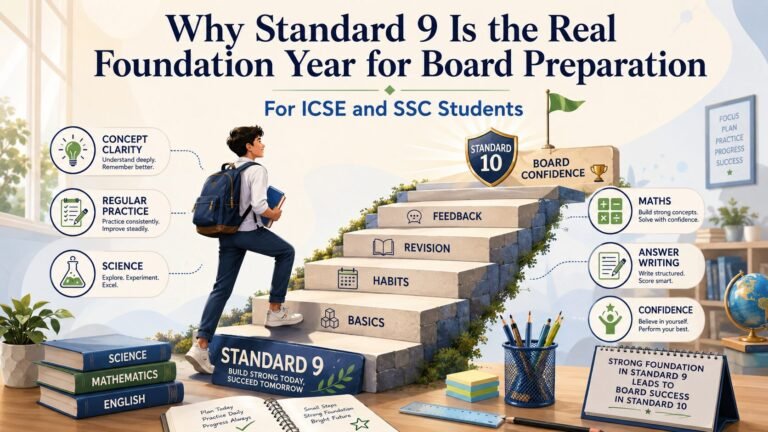
Many parents treat Standard 10 as the main year and Standard 9 as a lighter year. But Standard 9 is often the year where the real foundation is tested. The subjects become more serious, the child has to study with more independence, and earlier gaps become more visible.
If a student enters Standard 10 with weak habits, the year can feel stressful from the beginning. The child has to handle new chapters, revision, tests and old doubts at the same time. This can be avoided when support begins earlier.
Starting academic support in Standard 7, 8 or 9 does not mean increasing pressure on the child. In fact, the right support can reduce pressure. The child gets time to understand slowly, practise regularly and build confidence before the board year becomes urgent.
The learning environment matters
Parents should also think about how the class feels for the child. Young students learn better when they feel safe, respected and comfortable. A child should be able to say, “I did not understand,” without fear.
This is especially important for students who are shy, anxious or afraid of making mistakes. If the environment is too harsh or crowded, the child may stop asking questions. If the environment is calm and encouraging, the child slowly becomes more open.
A good class should have discipline, but it should not make the child feel small. It should correct mistakes without embarrassment. It should help students take studies seriously while still feeling supported.
How Dr. Manjiri Rathod’s Classes supports SSC students in Nashik
Dr. Manjiri Rathod’s Classes are designed as small-batch academic mentorship for school students in Nashik. For SSC Standards 7 to 10, the focus is on Science and Mathematics. The teaching is built around strong foundations, clear concepts and board-ready confidence.
Dr. Manjiri brings a PhD Life Sciences background and over 20 years of teaching and mentoring experience. For younger students, this academic depth is brought into the classroom in a simple and student-friendly way. The aim is to make Science and Maths clearer, not heavier.
The classes follow The MJR Clarity Method. First, the child’s learning gaps are understood. Then the concept is built carefully. Related ideas are connected so the child can see how chapters fit together. After that, students practise writing and solving in a board-aware manner. Regular feedback helps reinforce learning.
The batch size is deliberately small, usually 5 to 6 students. This allows personal attention, better doubt-solving and a more comfortable learning space. For parents, it also means the child is not lost in a crowd.
Questions parents can ask before enrolling
Before choosing SSC classes in Nashik, parents can ask a few simple questions. How many students are there in one batch? Does the class teach both Science and Mathematics with proper attention? Are doubts encouraged during class? Is written work checked regularly? Are diagrams and Maths steps corrected?
Parents can also ask how the teacher identifies learning gaps. This is important because many children do not openly say what they have not understood. A good teacher should be able to notice these gaps through class interaction, written work and regular feedback.
It also helps to ask how the class prepares students for exams. The answer should include concept clarity, practice, answer writing and revision. If the focus is only on completing portions, the child may still struggle when it is time to write the paper.
A final word for parents
The right SSC class should make your child feel clearer, steadier and more confident. It should help the child understand Science, practise Mathematics, ask doubts without hesitation and write answers properly.
For Standards 7 to 10, the goal is not to create fear of the board exam. The goal is to build the foundation early, so the child can move towards Standard 10 with better habits and less stress.
If you are looking for SSC classes in Nashik for Science and Mathematics, Dr. Manjiri Rathod’s Classes offer small-batch academic mentorship with personal attention, concept clarity and board-aware preparation.
FAQs
What should parents look for in SSC classes in Nashik?
Parents should look for concept-based teaching, small batch size, regular doubt-solving, written practice, Maths step correction, Science diagram guidance and personal feedback. The class should help the child understand better, not only complete chapters.
Are small-batch SSC classes better for Standards 7 to 10?
Small batches are often helpful because students receive more attention. In a batch of 5 to 6 students, the teacher can notice doubts, correct mistakes and support quieter children more closely.
Why do SSC students need support in Science and Mathematics?
Science and Mathematics need regular understanding and practice. If basics are weak, later chapters become harder. Early support helps students build clarity before the board year becomes stressful.
Should SSC students start classes before Standard 10?
Yes, many students benefit from starting earlier. Standards 7, 8 and 9 help build the foundation for Standard 10. Early support gives students time to improve without last-minute pressure.
How does Dr. Manjiri Rathod’s Classes support SSC students?
Dr. Manjiri Rathod’s Classes support SSC students in Science and Mathematics through small batches, personal attention, concept clarity, board-style practice and regular feedback. The teaching follows The MJR Clarity Method, which helps students move from gaps to clearer understanding.