

From “I Know This” to “I Can Write This”: Improving Science Answers
Many parents hear a familiar sentence after a Science test: “I knew the answer, but I could not write it properly.”
The child may have understood the lesson in class. At home, they may explain the topic reasonably well in everyday language. Yet the written answer looks brief, unclear or incomplete. Important scientific terms are missing, the sequence is disturbed, or the student stops after writing the first point.
This can be frustrating for both the child and the parent. The effort appears to be there, and the understanding seems present, but the marks do not reflect it.
In many such cases, the student does not need to study the entire chapter again. The real need is to learn how to turn understanding into a clear, accurate and exam-ready answer.
The following student journey represents a pattern commonly seen among school students and shows how the MJR Clarity Method can help address it.
A student who seemed to understand Science
Let us take the example of Aarav, a Standard 9 student. Aarav enjoyed classroom discussions and followed Science explanations quite comfortably. When asked about photosynthesis, digestion or the circulatory system, he could describe the broad idea in his own words. His parents therefore assumed that Science was going well.
His test papers showed a different picture.
His answers were often too short. He used casual language instead of scientific terms. In process-based questions, he missed the correct sequence. Diagrams were attempted only when compulsory, and the labels were sometimes incomplete.
Aarav would look at the marks and say, “But that is what I meant.” He was right in one sense. The basic idea was present. The answer paper, however, could show only what he had actually written.
What the notebook revealed
A closer look at Aarav’s written work began to show a pattern. He often wrote the first idea that came to mind and stopped. If a question asked him to explain a process, he wrote two general sentences instead of presenting the stages clearly. Definitions were written in his own words, but key terms were missing. His diagrams were hurried because he had not practised them regularly.
For example, when asked to explain transpiration, Aarav wrote:
Transpiration is when plants lose water from their leaves. It helps the plant.
The answer showed some understanding. He knew that water was lost through leaves, but the response did not explain how the loss occurred, where it occurred, or why the process mattered.
A stronger answer would require terms such as water vapour, stomata and aerial parts of the plant. Depending on the question, it may also need the role of transpiration in cooling and the upward movement of water.
The gap was no longer difficult to see. Aarav knew the topic broadly, but he had not learnt how to express that knowledge with enough scientific accuracy.
Understanding and writing are different skills
Listening to an explanation and writing an answer independently place different demands on a student.
During a lesson, the teacher provides structure. The concept unfolds in sequence, examples support the explanation, and difficult terms are introduced in context. The student can follow the teacher’s thinking.
During a test, the student must create that structure alone. They have to recall the concept, understand the question, choose the right points and write them in a logical order.
Some students can speak freely about a topic but become unsure when they have to put it on paper. Others remember the concept but cannot recall the exact scientific vocabulary. A few students know several points and still fail to arrange them into a complete answer.
These are writing gaps, and they need targeted practice.
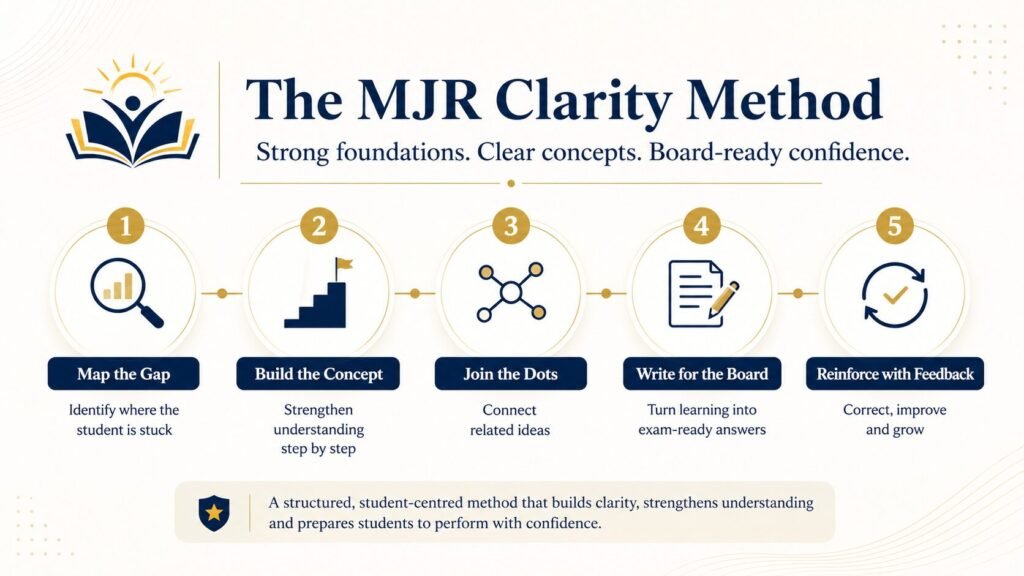
Step 1: Map the Gap
The first step in the MJR Clarity Method is Map the Gap.
For Aarav, the issue was not a complete lack of understanding. Repeating the same chapter explanation from the beginning would have had limited value. His difficulty lay mainly in scientific vocabulary, answer structure and written recall.
His oral responses, notebooks and test papers were observed together. This helped separate what he understood from what he struggled to express.
The pattern became clearer:
- He knew the broad concept.
- He missed essential terms.
- He wrote process-based answers without sequence.
- He rarely checked whether the question needed a definition, reason, diagram or detailed explanation.
- He had very little practice writing without looking at the textbook.
Once the problem was identified accurately, the teaching could focus on the missing skill.
Building scientific vocabulary through meaning
Aarav did not need a long list of words to memorise. He needed to understand which terms belonged to the concept and why they mattered.
For a topic such as transpiration, words like stomata, water vapour, evaporation and aerial parts were introduced through the process itself. The terms were connected to the leaf diagram and to the movement of water through the plant.
Aarav was then asked to explain the process in simple language first. Once the idea was clear, the scientific terms were added to strengthen the answer.
This sequence made vocabulary easier to remember. The words were no longer floating separately from the topic. Each term had a place and purpose.
The same approach was used with definitions. Aarav learnt that he could understand a definition in his own words, while the final written version still needed certain key terms for accuracy.
Learning to recognise what the question asks
Aarav also needed to slow down before writing.
He often began answering as soon as he recognised the topic. As a result, he sometimes wrote a description when the question asked for a reason, or gave a definition when an explanation was needed.
He began practising instruction words such as:
Define: Give the accurate meaning.
State: Write the required fact briefly.
Explain: Present the idea with enough detail.
Give reasons: Connect the cause with the outcome.
Differentiate: Compare both sides using clear points.
Draw and label: Show the required structure and identify its parts.
This small habit improved the relevance of his answers. He learnt to respond to the question on the paper rather than writing everything he remembered about the chapter.
Step 4: Write for the Board
Write for the Board is the fourth stage of the MJR Clarity Method, and it became especially important in Aarav’s case.
He began practising answers in a simple sequence:
- Identify what the question requires.
- Recall the main concept.
- List the essential points or keywords mentally.
- Write them in a clear order.
- Add a diagram when it improves or completes the answer.
- Read the answer once before moving ahead.
This process initially took a little longer. Aarav had been used to writing quickly and stopping early. With practice, organising the answer became easier.
His improved answer on transpiration now read more like this:
Transpiration is the loss of water in the form of water vapour from the aerial parts of a plant, mainly through the stomata present on the leaves. It helps cool the plant and supports the upward movement of water and minerals from the roots.
The answer was still concise. It now contained the required terminology, the main process and its significance.
Before-and-after improvement is often gradual
The change did not happen through one corrected answer.
Aarav first began remembering more keywords. His answers became slightly longer and more organised. He then started recognising when a process needed a clear sequence. Diagram practice improved his labels and made the written explanation easier to recall.
Some mistakes continued for a while. He occasionally returned to casual language or left out one important point. These errors were corrected without treating the whole answer as a failure.
The aim was to help him see precisely what was missing.
Over time, his answer papers showed greater control. The broad understanding that had always been present was now becoming visible to the examiner.
Step 5: Reinforce with Feedback
Feedback played an important role in making the improvement last.
Instead of receiving comments such as “Write more” or “Learn properly”, Aarav received specific guidance:
“Your concept is correct, but use the term ‘water vapour’.”
“You have written the first stage. Add what happens next.”
“The diagram is clear, but two labels are missing.”
“This answer needs a reason, not only a definition.”
After correction, he was asked to rewrite selected answers later without copying. This helped check whether he had understood the feedback.
The second attempt often showed the real progress. Aarav was no longer looking at the correct answer and reproducing it immediately. He had to recall the improvement independently. Repeated feedback gradually reduced repeated mistakes.
What his parents began to notice
The first change Aarav’s parents noticed was not a dramatic jump in marks. His language about studying became more specific.
Earlier, he would say, “I have done the chapter.”
Later, he began saying:
“I understand the process, but I need to practise the answer.”
“I forgot two keywords in this question.”
“I should draw the diagram once more.”
“This question asks for a reason, so I need to explain why it happens.”
These statements showed greater awareness. Aarav was learning how to assess his own preparation.
His written answers became clearer, and his test performance started improving. More importantly, he felt less frustrated because he could finally understand why marks had been lost and what he could do differently.
Why small batches help answer-writing improvement
Answer writing needs individual correction.
Two students may write weak answers for different reasons. One may lack concept clarity. Another may know the concept but miss vocabulary. A third may write too much without answering the question directly.
In a crowded class, these differences can be difficult to notice.
At Dr. Manjiri Rathod’s Classes in Nashik, batches are deliberately limited to 5 to 6 students. This allows written work to be observed more closely. The teacher can notice recurring patterns and give feedback that matches the student’s actual need.
Students also become more comfortable asking small but important questions:
“How much should I write?”
“Is this keyword necessary?”
“Should I draw the diagram here?”
“Why did I lose a mark in this answer?”
These questions help students become more thoughtful writers.
The takeaway for parents from this example
When a child says, “I knew the answer,” it helps to look at the answer paper before assuming that the child did not study enough.
Check whether the concept is present. Then look for the specific gap.
Are keywords missing? Is the answer incomplete? Is the sequence unclear? Has the child misunderstood the instruction? Are diagrams being avoided? Is the student only reading answers without writing them?
The solution becomes much clearer once the problem is named accurately.
More study time may not automatically improve the answer. Focused writing practice, correction and feedback often make a greater difference.
A final word for parents
Science marks depend on understanding, recall and expression working together.
A student may know the chapter and still need help turning that knowledge into an exam-ready answer. This skill develops through careful observation, scientific vocabulary, written practice and specific feedback.
The MJR Clarity Method helps separate a concept gap from a writing gap. It then gives the student a clear path towards improvement.
At Dr. Manjiri Rathod’s Classes, the goal is to help students move from “I know this” to “I can explain and write this clearly.” That is when the answer paper begins to reflect the learning that has already taken place.
FAQs
Why do students understand Science but write weak answers?
Students may understand the broad concept but struggle with recall, scientific vocabulary, sequence or answer structure. Written practice helps them learn how to present their understanding clearly.
How can students improve Science answer writing?
Students should first understand the concept, identify the keywords, read the question carefully and practise writing without looking at the textbook. Specific correction from the teacher also helps.
Should Science answers be memorised word for word?
Students need to remember important terms and accurate definitions, but complete answers should be built on understanding. This helps them respond even when the question is framed differently.
Why is feedback important for answer writing?
Feedback shows the student exactly what is missing. It may point to a keyword, sequence, diagram label or unclear explanation. Rewriting the answer later helps prevent the same mistake from returning.
How does the MJR Clarity Method help with Science answers?
The Method identifies whether the problem lies in understanding or expression. Students then work on concepts, vocabulary, board-style writing and correction through regular feedback.