

From Confusion to Confidence: How the MJR Clarity Method Works in a Student’s Learning Journey
Parents often notice the problem before they can name it.
The child is attending school regularly. Homework is being completed. The notebooks look reasonably full. Marks may not be alarming either. Yet something seems unsettled. The child hesitates when asked to explain a chapter, avoids a certain type of Maths problem or says, “I understood it in class, but I could not write it in the test.”
This is where academic support needs to look beyond the next chapter or upcoming exam.
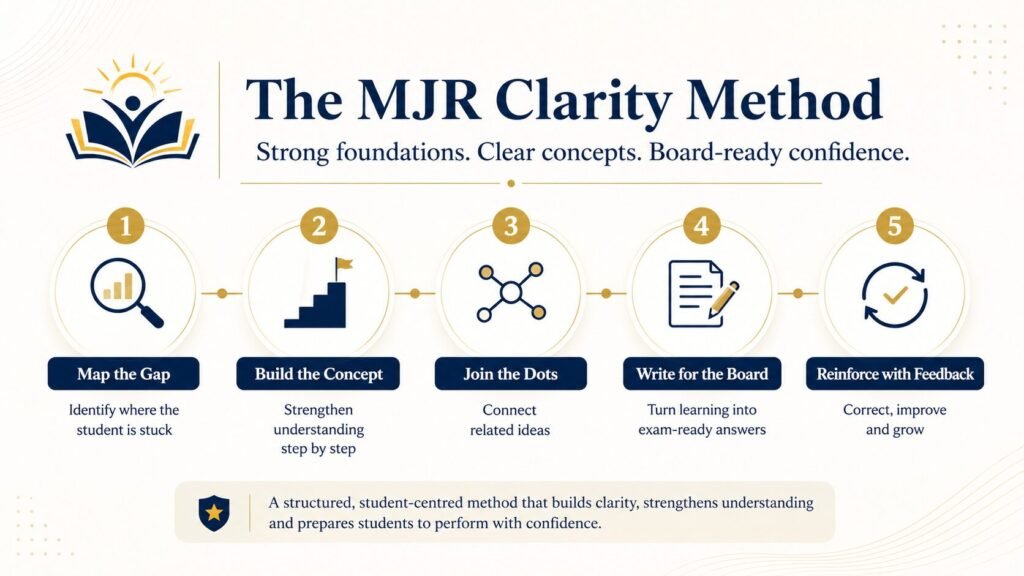
The MJR Clarity Method is a five-step teaching framework used at Dr. Manjiri Rathod’s Classes in Nashik. It helps identify where a student is stuck, rebuild the learning carefully, connect related ideas, improve answer writing and strengthen progress through regular feedback.
The five steps are:
Map the Gap
Build the Concept
Join the Dots
Write for the Board
Reinforce with Feedback
To understand how the method works, it helps to follow a student through the learning journey.
Meet a student who seems to be managing
Let us take an illustrative example.
Riya is a Standard 9 student. She attends school, completes her work and studies before tests. Her marks are average. She enjoys some Biology chapters but finds Physics and Chemistry harder. She also says that Maths becomes confusing when the question looks different from the example taught in class.
At home, she often says she has understood the chapter. During a test, however, she forgets important terms, writes very short answers and leaves diagrams for the end. In Maths, she starts the sum correctly but loses track after two or three steps.
Her parents initially think she needs to study longer. Riya begins spending more time with her books, but the results do not change much. She becomes quieter whenever Science or Maths is discussed.
This is a common situation. The child is making an effort, yet the effort is not reaching the real difficulty.
Step 1: Map the Gap
The first step is to understand where the problem actually begins.
Riya’s marks alone do not explain enough. Her written work, class responses, doubts and repeated mistakes offer a clearer picture.
In Science, she understands the broad idea but struggles with scientific vocabulary and answer structure. She can explain the chapter casually, though the written answer misses important points. Her diagrams are incomplete because she has not practised them regularly.
In Maths, she can follow a solved example. She becomes unsure when the question changes because she has remembered the steps without fully understanding the method.
There is also a confidence gap. Riya hesitates to ask questions because she feels she should already know the answer.
Once these patterns are visible, the support becomes more focused. She does not simply need “more Science” or “more Maths”. She needs help with specific concepts, written expression, diagram practice and independent problem-solving.
That is what Map the Gap is meant to do.
Step 2: Build the Concept
The next step is to rebuild the learning from the point where it became unclear.
In Science, Riya is encouraged to understand the process before memorising the answer. A chapter on photosynthesis, for example, is broken into smaller parts. She first understands what the plant needs, what happens inside the leaf and how sunlight, chlorophyll, water and carbon dioxide are connected.
The scientific terms are introduced after the idea begins to make sense. This helps her remember the words because they now belong to a process she understands.
In Maths, the method is explained slowly. Instead of copying a solved example, Riya is asked why a particular step is used. She attempts simpler variations first, then moves towards more challenging questions.
The purpose is to make the concept stable enough for her to use it independently.
As the basics become clearer, Riya begins asking more questions. She is no longer trying to hide confusion. She has started to see that a doubt is a useful part of learning.
Step 3: Join the Dots
Students often struggle because every chapter feels like a separate collection of facts. The Join the Dots stage helps Riya see how ideas are connected.
In Biology, she learns how cells form tissues, tissues form organs and organs work together in systems. A chapter on transport in plants connects with roots, xylem, leaves, transpiration and photosynthesis. The topics begin to feel like parts of one larger story.
In Physics, a concept may connect with Mathematics. Understanding measurement, formulas and basic calculation helps her handle numerical questions with greater confidence.
These links improve memory because the ideas no longer sit in isolation. One concept begins to remind her of another.
Riya also becomes better at explaining the subject in her own words. Earlier, she depended heavily on textbook lines. Now she can describe the process first and then bring in the required scientific terms.
This change matters because understanding has started to become more organised.
Step 4: Write for the Board
Riya’s next challenge is turning that understanding into a good written answer.
She learns that different questions need different responses. A definition needs accuracy. A reason needs a clear cause. A process needs sequence. A comparison needs both sides. A diagram needs correct labels and neat presentation.
In Science, she begins practising short answers, long answers and diagrams regularly. Her teacher points out where important words are missing and where the explanation becomes vague.
In Maths, she is encouraged to show the method properly. Skipped steps are corrected. She learns to keep the working clear so that a small mistake can be found easily.
At first, this feels slower. Riya has to think about what the question is asking and how the answer should be organised. With practice, the process becomes more natural.
She begins to understand why she previously lost marks despite knowing the chapter. The problem was often in the way the learning appeared on paper.
Step 5: Reinforce with Feedback
The final step keeps the improvement from fading away. Riya’s work is checked regularly. The feedback is specific.
Instead of hearing, “Study harder,” she may be told that her answer is correct but needs two scientific terms. A diagram may need one missing label. A Maths solution may need clearer working between the second and third steps.
She corrects the answer and attempts it again later. This second attempt is important. It helps her replace the old habit with a stronger one. The correction is no longer something she copies and forgets.
Over time, the same mistakes appear less often. Her answers become clearer. She attempts diagrams without avoiding them. In Maths, she is more willing to try a fresh question before asking for help.
Feedback also changes the way she sees mistakes. They no longer feel like proof that she cannot do the subject. They show her what to work on next.
What begins to change in the student
The first visible change may not be a dramatic jump in marks.
Riya begins asking better doubts. She can explain where she gets stuck. She becomes more willing to attempt difficult questions. Her notebooks show clearer steps, stronger answers and better diagrams.
Her preparation also becomes calmer. She no longer needs to reread the same chapter repeatedly without knowing whether she is ready. She has a better idea of what to revise and what to practise.
Marks begin improving because the learning underneath has become stronger. The more important change is that Riya now trusts her own ability to understand and improve.
Confidence grows from these small academic experiences.
Why the small-batch format matters
The MJR Clarity Method depends on observation and interaction.
A teacher needs to notice how the child thinks, writes, solves and responds. This becomes difficult when a student is one among many in a crowded room.
At Dr. Manjiri Rathod’s Classes, batches are deliberately kept small, usually with 5 to 6 students. This allows Dr. Manjiri to notice hesitation, repeated mistakes and weak learning habits early.
Students also feel more comfortable admitting that they have not understood something. A shy child is less likely to remain invisible. Written work can be checked more carefully, and feedback can be more specific.
The small-batch format is therefore part of the academic approach. It helps make personal mentorship practical.
How the journey differs across subjects and boards
The five steps remain the same, though the learning need may change.
For SSC students in Standards 7 to 10, the focus is Science and Mathematics. A student may need stronger textbook understanding, clearer Maths methods, regular written practice and better board-style answers.
For ICSE students in Standards 7 to 10, the support is Science-focused, including Biology. Scientific vocabulary, diagrams, depth of explanation and structured writing often need more attention. Mathematics and Chemistry may also be supported depending on the student’s needs and batch structure.
For Standards 11 and 12, the focus is Biology. Students need help managing deeper concepts, detailed terminology, diagrams, long chapters and revision.
The Method adapts to the student, subject and stage of learning.
What parents may notice at home
Parents may begin seeing small changes before the next major exam.
The child may explain a chapter more clearly. Homework may take less time because the student knows how to begin. A difficult subject may create less resistance. The child may speak more openly about doubts.
Parents may also hear more specific sentences:
“I understand the concept, but I need to practise the diagram.”
“I made a mistake in the second Maths step.”
“I need to use these keywords in the answer.”
These are encouraging signs. The child is becoming more aware of the learning process.
That awareness helps students become more independent over time.
A final word for parents
A student’s journey from confusion to confidence rarely happens through one explanation or one test.
It happens when the real gap is identified, the concept is rebuilt, related ideas are connected, written expression is practised and feedback is used properly.
The MJR Clarity Method gives this journey a clear structure.
At Dr. Manjiri Rathod’s Classes in Nashik, the Method is supported by small batches, personal attention and a safe, respectful learning environment. The aim is to help students understand where they are stuck and show them how to move forward, one clear step at a time.
FAQs
How long does it take for a student to show improvement?
The timeline varies from child to child. Some students respond quickly once the main gap is identified. Others need more time to rebuild basics, practise writing and develop confidence.
Does the MJR Clarity Method work for both Science and Maths?
Yes. The five-step approach can be applied to both subjects. Science may need concept explanation, terminology and diagrams, while Maths may need clearer methods, steps and guided practice.
Why is feedback included as a separate step?
Feedback helps students understand exactly what needs correction. It also gives them a chance to improve the same skill and avoid repeating the mistake.
How does the small-batch format support the Method?
Small batches allow closer observation, better doubt-solving and more personal feedback. In a group of 5 to 6 students, the teacher can understand each child’s learning pattern more clearly.